
3-Position Motion Generation Four-Bar Linkage Synthesis using Unigraphics NX4 Sketch
In the real design problem, it will be more practical with 3 specified positions of a line in sequential order than 2-position synthesis. We can use a logical extension of the linkage synthesis technique described in [Four-bar linkage Synthesis using Unigraphics NX4 Sketch] to do the linkage synthesis with 3 positions.
Assume that we have to design the mechanism that move the link AB through 3 positions as shown below. The rectangle represents the limit of link AB, so link AB cannot interfere with the rectangle.

1) Draw link AB in its three design positions A1B1, A2B2, and A3B3 as shown above.
2) Draw construction lines from point A1 to A2 and A2 to A3

3) Bisect line A1A2 and line A2A3 and extend their perpendicular bisectors until they intersect with each other. Label the intersection O2.
4) Draw line O2A1. It's link 2.
5) Repeat the same for another end of the link. Draw construction lines from point B1 to B2 and B2 to B3


Further reading:
Assume that we have to design the mechanism that move the link AB through 3 positions as shown below. The rectangle represents the limit of link AB, so link AB cannot interfere with the rectangle.

1) Draw link AB in its three design positions A1B1, A2B2, and A3B3 as shown above.
2) Draw construction lines from point A1 to A2 and A2 to A3

4) Draw line O2A1. It's link 2.
5) Repeat the same for another end of the link. Draw construction lines from point B1 to B2 and B2 to B3

6) Bisect line B1B2 and line B2B3 and extend their perpendicular bisectors until they intersect with each other. Label the intersection O4.
7) Draw line O4B1. It's link 4.

8) Draw line O2M and set the same length as O2A1.
9) Draw line O4N and set the same length as O4B1.
10) Draw line MN and set the same length as A1B1.
11) Set angular dimension between O4B1 and O4N to any desired value e.g. 15 degrees.
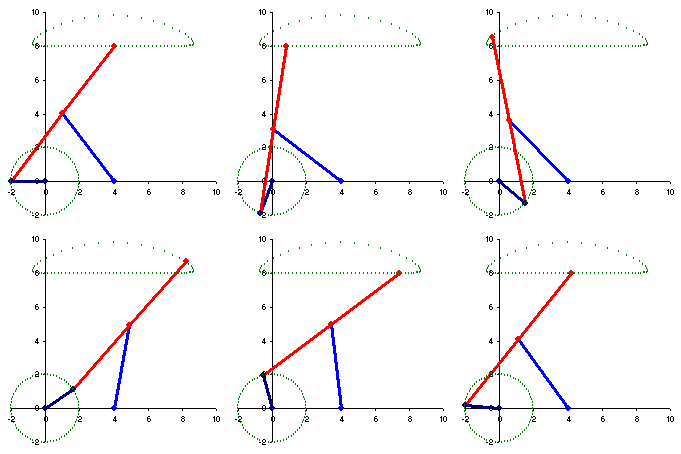
12) Select "Animate Dimension" Command in Unigraphics NX4 sketch and set lower limt to 0 and Upper limit to 56.355 (or any other value) and Steps/Cycle to 150 (the more steps, the smoother simulation).

See the results of four-bar linkage from three-position motion generation synthesis in the following video clip.
Further reading:
- Kinematic Synthesis of Linkages (Mechanical Engineering Series)
- Graphical solution of the branch and order problems of linkage synthesis for multiply separated positions
- Analysis of the Four-Bar Linkage: Its Application to the Synthesis of Mechanisms
- Kinematic Synthesis of Linkages
- Computer-aided synthesis of kinematic linkages (Massachusetts Institute of Technology. Dept. of Mechanical Engineering. Thesis. 1975. M.S)
- Computerized synthesis of straight-line four-bar linkages from inflection circle properties




Comments